Learn Japanese
Japanese in NEKO PEW PEW
Every Japanese word and phrase you hear or see in the game, with what it means. Play a few levels and you will know them all.
Giongo: words for sounds 擬音語
The game is full of them, so they are a good place to start.
Giongo (擬音語, gi-on-go, "words that copy sounds") are Japanese onomatopoeia: words like ドカン (dokan, kaboom) and にゃー (nyā, meow). English has these too, but Japanese has thousands, and people use them all the time, in everyday talk as well as in manga, anime and games.
They have a cousin, gitaigo (擬態語, "words that copy how things are"), which picture a movement or a feeling rather than a noise: ぴょん (pyon) is the look of a hop, and もぐもぐ (mogu mogu) the look of someone chewing with their mouth full. Together they are called オノマトペ (onomatope).
They are easy to learn from a game, because you hear each one at the very moment it happens.
Otsukare: nobody ever dies お疲れ
Why the counter at the bottom of the screen says お疲れ and not "kills".
お疲れ (otsukare) comes from 疲れる (tsukareru, to get tired), with a polite お in front. It means something like "you must be tired: thank you for your hard work". In Japan it is said all the time: to colleagues as they leave work, to a friend after a long day, to a team after a match.
In the NEKO PEW PEW universe, nobody ever dies. When you defeat a character they are not gone for good: they are warped away to somewhere in the clouds, or to some other realm, where they rest and wait for their chance to come back.
So instead of counting kills, the game says お疲れ to each one as they go, and counts how many you have sent off to rest. お疲れ × 12 means twelve of them are having a well-earned break.
Every word in the game
In the order you are likely to meet them. More arrive with the Boss Fox at the full release.
Sounds
Giongo and their cousins, gitaigo. Each one is a sound effect in the game.
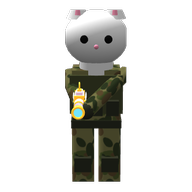
にゃっ!
nya!
Meow!
The cat's cry when you scratch, with F or a right-click.

ドカン
dokan
Kaboom!
A grenade going off.
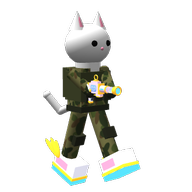
ぴょん
pyon
Boing! (a hop)
When you jump. It is gitaigo: it pictures the hop more than the noise.

もぐもぐ
mogu mogu
Munch munch
Eating a golden apple to get your health back. Gitaigo too: it pictures chewing.

パクパク
paku paku
Chomp chomp / gobble gobble
Eating a slice of bacon. Gitaigo again: the mouth opening and shutting in big, quick bites.
When an animal bumps into you
The animals are friendly. When one runs into you, you hear a greeting.

やっほー
yahhō
Yoo-hoo! / Hey there!
A cheerful hello, to a friend.

こんにちは
konnichiwa
Hello / Good afternoon
The everyday greeting.
はじめまして
hajimemashite
Nice to meet you
Said only on meeting someone for the first time. It is the first half of the greeting below, and is often said on its own.
はじめまして、よろしくお願いします
hajimemashite, yoroshiku onegaishimasu
Nice to meet you, and I look forward to knowing you
The full, polite greeting for meeting someone for the first time: はじめまして means "this is the first time", and よろしくお願いします asks them to treat you kindly from now on.
よろしく
yoroshiku
Nice to meet you / I'm counting on you
Said after meeting someone, and at the start of anything done together. There is no one English word for it.
よろしくね
yoroshiku ne
The same, more friendly
The ね (ne) on the end makes it softer and warmer.
When you send an animal off to rest
What you hear when you defeat an animal. See “Otsukare” above for why.
お疲れ!
otsukare!
Good work! / Thanks for your effort
The main line, said in a few different ways. Casual, between friends and colleagues.
お疲れさま
otsukaresama
Thank you for your hard work
A little more polite.
お疲れさまです
otsukaresama desu
Thank you for your hard work (polite)
The form used at work, to anyone.
よくできました
yoku dekimashita
Well done!
What a teacher writes on good homework.
がんばったね
ganbatta ne
You did your best, didn't you
From 頑張る (ganbaru), to try hard. Kind and encouraging.
お疲れ × 12
otsukare × 12
Twelve sent off to rest
Not spoken: it is the counter at the bottom of the screen.
And a few more

はやい、はやい!
hayai, hayai!
So fast, so fast!
Said in place of お疲れ when you catch the cheetah and wear his shoes.
ちゃんとやりなさい!
chanto yarinasai!
Do it properly!
When you lose a life. It is what a parent or a teacher says: a telling-off, but not an angry one.